Sunday, 3 March 2013

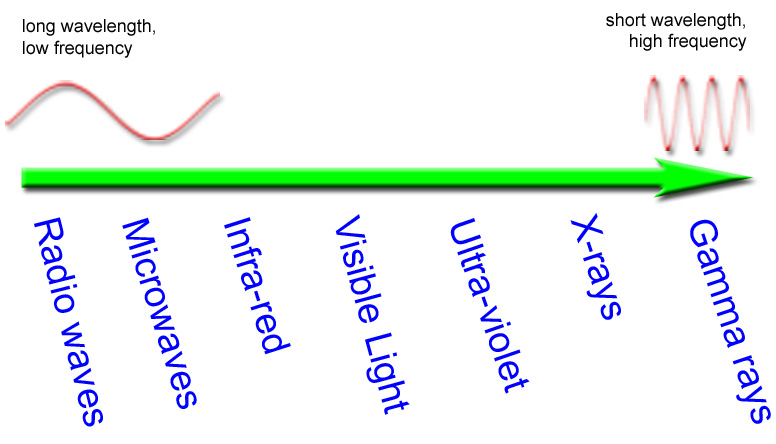
3.11 identify the order of the electromagnetic spectrum in terms of decreasing wavelength and increasing frequency, including the colours of the visible spectrum

As you go up the electromagnetic spectrum wavelength decreases and frequency increases.
The same is true for visible light; with red being the longest wavelength and lowest frequency and violet being the shortest wavelength and highest frequency of all visible light.

3.10 understand that light is part of a continuous electromagnetic spectrum which includes radio, microwave, infrared, visible, ultraviolet, x-ray and gamma ray radiations and that all these waves travel at the same speed in free space

The electromagnetic spectrum is a range of different frequency waves, one section of the spectrum is visible light (light we can see.) All of the waves in the electromagnetic spectrum travel at the same speed when they are in a vacuum.
solarwiki.ucdavis.edu

3.9 understand that waves can be diffracted through gaps, and that the extent of diffraction depends on the wavelength and the physical dimension of the gap.

Diffraction can happen through a gap, when waves go through a narrow space, on continuing they spread out again. The smaller the gap, in comparison to the wave length, the larger the diffraction.
schoolsphysics,co,uk

3.8 understand that waves can be diffracted when they pass an edge

As this diagram shows, when a wave hits an edge, as it carries on it spreads out into the space beyond the edge. This happens with radio waves and hills, and water and islands.
3.7 use the above relationships in different contexts including sound waves and electromagnetic waves

calcresult.com
Wave speed= frequency x wave length
Frequency= 1/time period


You should be able to manipulate these equations to answer questions that may ask in a different order; use the triangle method.

3.6 use the relationship between frequency and time period

Frequency= 1/ time period
f=1/T

3.5 know and use the relationship between the speed, frequency and wavelength of a wave


wave speed = frequency × wavelength
v = f × λ